As the Loyalty Marketer’s Association, Loyalty360 provides insights and guidance to help companies build lasting and profitable relationships with customers. One critical building block that leads to customer loyalty is Customer Experience. To kick-off a period of research, recognition and information sharing that is focused on Customer Experience and Engagement – culminating at the 2014 Engagement & Experience Expo – we are pleased to provide a snapshot of the current state Customer Experience strategies.
A more in-depth assessment will be published in the Customer Experience Landscape study, to be released this November at Engagement & Experience Expo. Click here to participate in the study, and receive a free copy of the report.
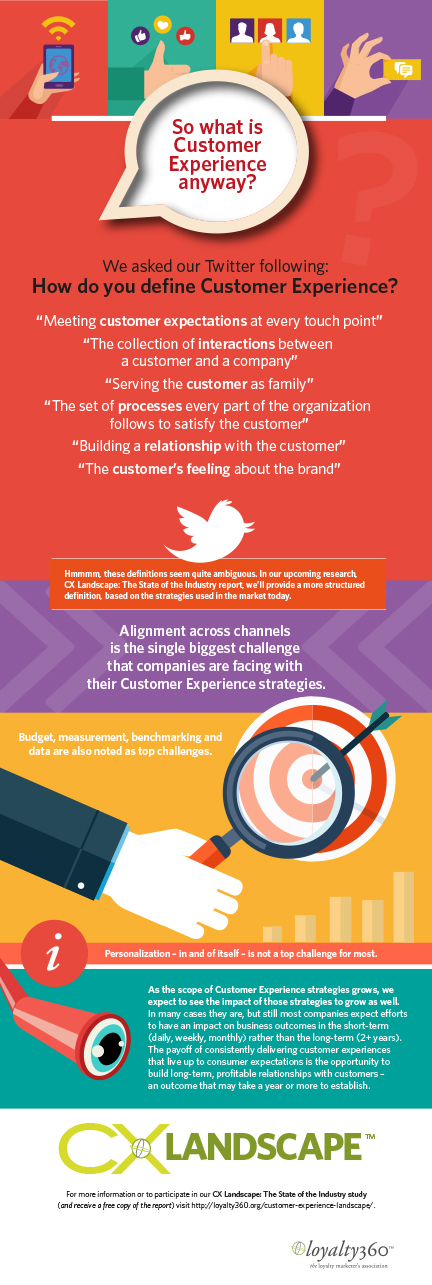
So what is Customer Experience anyway? In today’s climate, where Chief Customer Officers belly up to the boardroom table with Chief Marketing Officers and companies proudly tout allegiance to a customer-centric strategy, Customer Experience strategies are more all-encompassing than ever before.
Q. We asked our Twitter following: How do you define Customer Experience?
“Meeting customer expectations at every touch point”
“The collection of interactions between a customer and a company”
“Serving the customer as family”
“The set of processes every part of the organization follows to satisfy the customer”
“Building a relationship with the customer”
“The customer’s feeling about the brand”
Hmmmm, these definitions seem quite ambiguous. In our upcoming research, CX Landscape: The State of the Industry report, we’ll provide a more structured definition, based on the strategies used in the market today.
In the days of yore, Customer Experience was narrowly defined as a function of Operations, specifically call centers, contact centers, customer care or point of sale. Just as the definition of Customer Experience has become more esoteric, ownership of the strategies and outcomes has as well. Today, Operations holds sole responsibility for CX very rarely. More commonly, more than one group is ultimately held accountable.
As organizations are more broadly defining Customer Experiences, the number of ways in which customers can interact and transact with brands has grown. With that, come challenges.
Alignment across channels is the single biggest challenge that companies are facing with their Customer Experience strategies. Lack of communication and coordination across teams can stymie delivery of consistent and positive multi-channel customer experiences.
Budget, measurement, benchmarking and data are also noted as top challenges.
We hear a lot about the importance and complex nature of delivering personalized customer experiences, but personalization – in and of itself – is not a top challenge for most.
As the scope of Customer Experience strategies grows, we expect to see the impact of those strategies to grow as well. In many cases they are, but still most companies expect efforts to have an impact on business outcomes in the short-term (daily, weekly, monthly) rather than the long-term (2+ years). The payoff of consistently delivering customer experiences that live up to consumer expectations is the opportunity to build long-term, profitable relationships with customers – an outcome that may take a year or more to establish.
For more information or to participate in our CX Landscape: The State of the Industry study (and receive a free copy of the report) visit customer-experience-landscape.